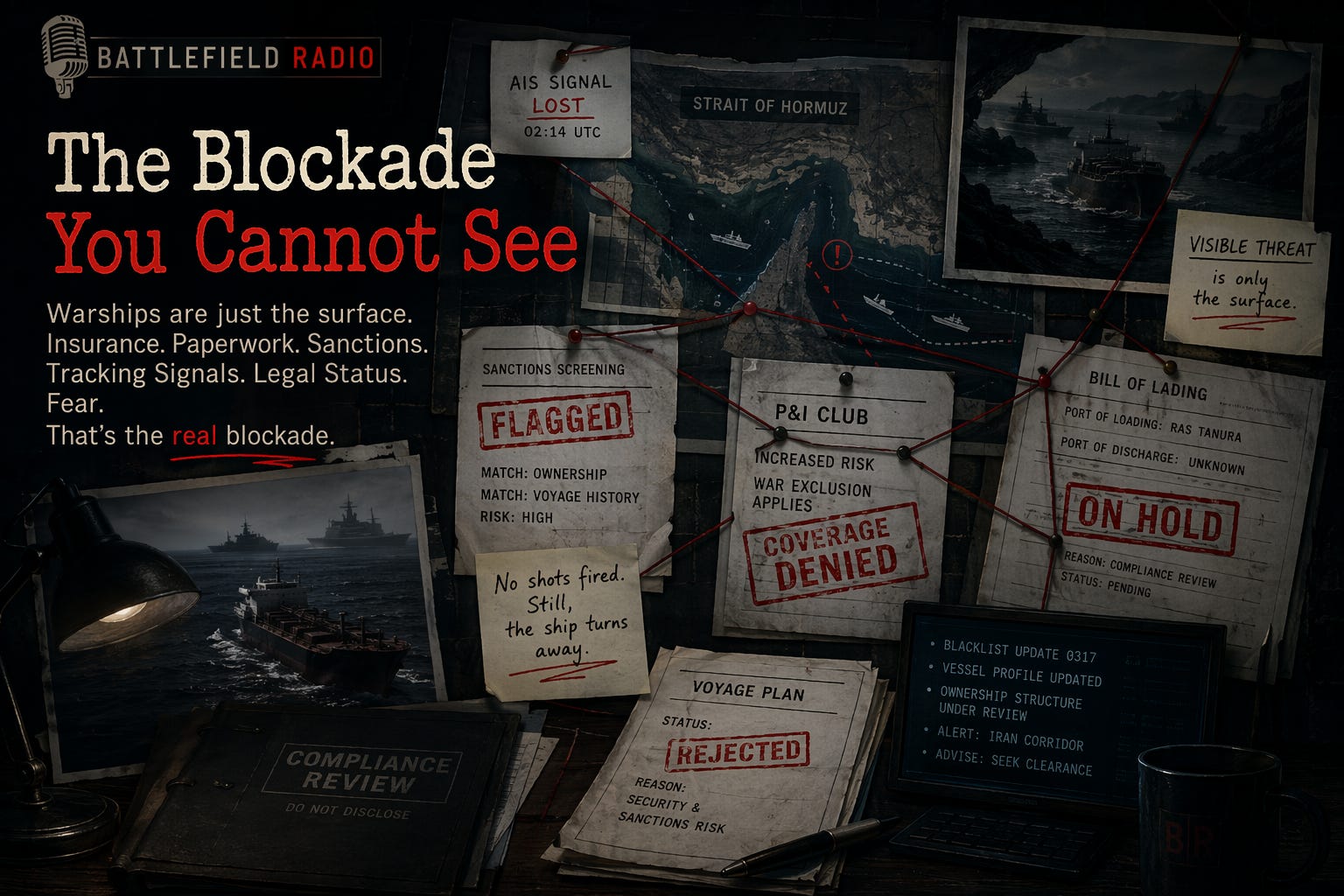
The Blockade You Cannot See

The real story in Hormuz is not missiles or tankers, it is permission
Most coverage of the U.S. blockade in the Strait of Hormuz is still stuck at the most obvious layer. Oil prices spike, tankers turn around, China complains, Russia calls it destabilizing, and everyone asks whether the world is about to run out of fuel. That is the surface-level version of events, and it is true as far as it goes. After Washington announced the blockade on traffic to and from Iranian ports, Reuters and AP reported that ships began reversing course, oil pushed back above $100 a barrel, and traffic through the region fell sharply even before any dramatic boarding action played out on television. Reuters also reported that more than 10,000 U.S. personnel, more than a dozen warships, and dozens of aircraft were part of the enforcement posture, while AP said ships linked to Iranian trade were halting, disguising routes, or turning back.
But the real story is not naval in the way most people imagine. It is administrative. The uncommon angle here is that this blockade is less about sinking ships than about deciding who gets to trade, under what paperwork, with what insurance, and under whose definition of legitimacy. Washington is trying to prove that in a fragmented world economy, the global commons still runs through American permission structures. The destroyers matter, but the bigger weapon is uncertainty. If a shipmaster thinks his insurer may void coverage, his owner may get sanctioned, his cargo may be stranded, and his next port may refuse him, then the blockade has already worked before the first boarding ladder ever goes over the side. That is why this crisis is more important than a simple oil shock, because it is testing whether the United States can still govern commerce at sea by combining warships, sanctions, intelligence, and legal ambiguity into one coercive system.