
The Circle Is the Plan
Why the people around you matter more than the gear in your closet

Every preparedness plan eventually runs into people.
Not food.
Not water.
Not batteries.
Not radios.
Not firearms.
Not bug-out bags.
People.
Family. Neighbors. Friends. Coworkers. In-laws. Church members. Veterans. Nurses. Mechanics. Cops. Retirees. Teenagers. Busy bodies. The guy with every tool in the world but no emotional control. The woman who knows everyone on the block and cannot keep a secret. The cousin who never prepared but assumes your house is the backup plan. The neighbor who is calm, quiet, and always useful. The person who says, “Just tell me what needs done.” The person who shows up and immediately creates two new problems.
This is the part of preparedness most people do not want to touch because it is personal.
It is much easier to talk about gear than judgment.
It is easier to buy another filter than decide whether your brother-in-law belongs in your emergency circle.
It is easier to stockpile food than admit that one relative may become a security risk.
It is easier to talk about community than define boundaries.
But in a real emergency, your circle may become the difference between stability and collapse.
That circle can multiply your capacity, or it can consume it. It can bring medical knowledge, mechanical skill, security awareness, childcare, local intelligence, manpower, and emotional strength. Or it can bring gossip, panic, freeloading, ego, conflict, addiction, bad decisions, and operational noise.
The hard truth is this:
You are not just preparing supplies.
You are preparing a human system.
And human systems fail in ways no gear list can fix.
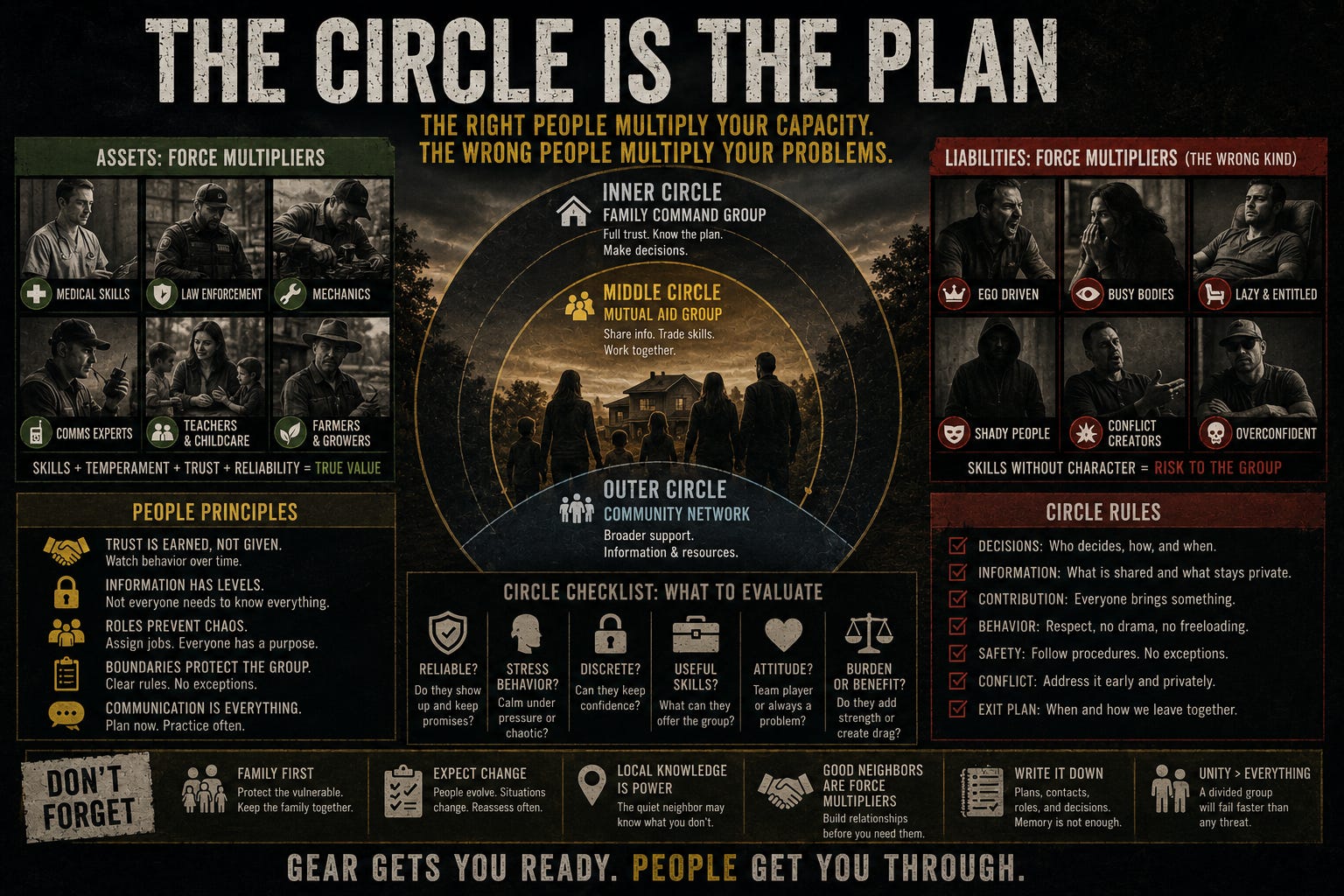
Skill is not the same as usefulness
Prepper culture tends to rank people by résumé.
Military background? Asset.
Law enforcement? Asset.
Doctor or nurse? Asset.
Mechanic? Asset.
Farmer? Asset.
Ham radio operator? Asset.
Hunter? Asset.
Maybe.
But maybe not.
Skill matters, but skill is not the same as usefulness.
A highly skilled person with a bad attitude can damage a group faster than an untrained person with discipline. A nurse who is calm, practical, and honest about limits is priceless. A nurse who tries to control every decision because “I know medical” can become a problem. A veteran who understands logistics, discipline, and restraint can be a major asset. A veteran who turns every family emergency into a tactical fantasy can create unnecessary danger. A mechanic who quietly keeps generators, vehicles, pumps, and tools running may be one of the most valuable people in the circle. A mechanic who refuses to document what he is doing and insults everyone else becomes a single point of failure.
The question is not “what credential do they have?”
The question is “how do they behave under stress?”
That is the part people miss.
A person’s useful value in a crisis is not just skill. It is skill multiplied by temperament, trustworthiness, humility, and reliability.
High skill with low trust is not an asset.
It is a controlled-access resource.
That sounds cold, but it is true. You may ask that person for help fixing a generator. You may not tell them where every supply is stored. You may accept advice from them without giving them decision authority. You may use their expertise while keeping them outside the inner circle.
That is the kind of distinction mature preparedness requires.
The three rings of trust
A good emergency circle is not one big group where everyone knows everything.
That is how people get loose with information, resources, expectations, and authority.
A better model is rings.
The inner ring is the household command group. These are the people who know the full plan, the supply picture, the fallback locations, the documents, the communication plan, and the decision thresholds. This ring needs high trust above all else. Skill is useful, but loyalty, judgment, discretion, and emotional stability matter more.
The middle ring is the mutual aid group. These are neighbors, relatives, friends, or local contacts who may coordinate with you but do not need total access. They may trade information, check on vulnerable people, share tools, help with transportation, repair equipment, or provide specialized knowledge. They are part of your resilience network, but not your full command structure.
The outer ring is the community ring. This includes local churches, volunteer groups, CERT teams, neighborhood associations, school contacts, amateur radio clubs, local businesses, and informal community leaders. These people may become very important in a disruption, but they do not need to know your household details.
Most people get into trouble because they treat everyone like inner ring or everyone like outsider.
Both are wrong.
Not everyone deserves full access.
Not everyone should be shut out.
The art is knowing where people belong.
The dangerous asset
Some people are assets on paper and liabilities in practice.
The most dangerous person in a preparedness circle is not always the lazy one.
It is often the competent person who cannot be led.
The former military guy who assumes rank carries over into the neighborhood.
The police officer who sees every unknown person as a suspect.
The medical professional who will not accept that supplies are limited.
The mechanically gifted person who gets angry when questioned.
The local “prepper expert” who knows gear but not teamwork.
The strong personality who fills every silence with orders.
In a crisis, confidence can be useful.
Overconfidence can be fatal.
A group under stress needs competence, but it also needs a shared operating picture. If one person keeps freelancing, overriding decisions, withholding information, escalating conflict, or treating every disagreement as weakness, the group becomes unstable.
That does not mean exclude every strong personality. Strong personalities can be valuable when they are disciplined. The key test is simple:
Can this person take direction when they are not in charge?
If the answer is no, they do not belong in the core circle.
They may still be useful. They may still have skills. But they should not be allowed to define the group’s rhythm.
A crisis does not make ego disappear.
It weaponizes it.
Helpy McHelperton and the problem of good intentions
Not every liability is malicious.
Some people are problems because they want to help too much.
The “helpy” person volunteers for everything, interrupts every task, starts side missions, gives advice nobody asked for, reorganizes supplies without telling anyone, goes to check on someone and disappears for two hours, or invites more people into the plan because “they needed help.”
This person can be kind, generous, and exhausting.
Good intentions without discipline create operational drag.
In emergency management, spontaneous volunteers can be a major resource. They can also overwhelm systems if they arrive unassigned, untrained, and unmanaged. The same thing happens at the household level. A helpful person needs a lane. Give them a specific job, a time limit, and a reporting structure.
“Check on Mrs. Davis next door and come back in 15 minutes.”
“Fill these containers and put them in this room.”
“Inventory batteries and write the count here.”
“Watch the kids for 30 minutes while we load the vehicles.”
That kind of person often does well with clear tasks. They do poorly with vague freedom.
Good hearts need structure.
Without structure, help becomes chaos wearing a smile.
The busybody problem
Every neighborhood has one.
They know who is home, who left, who owns a generator, who got a delivery, who is arguing, who has guests, and who is “acting weird.”
In normal times, the busybody is annoying.
In a crisis, the busybody is an information leak.
They may not be evil. They may even be useful because they know the social map. But they can spread information faster than you can control it. If they know you have supplies, half the block may know by dinner. If they know you are leaving, your empty house may become common knowledge. If they hear that your family is divided about whether to evacuate, they may turn your indecision into public rumor.
The busybody should not be given sensitive information.
But they should not always be ignored.
Sometimes they are the first to know who needs help, who is alone, which house has a medical issue, whose car is gone, or where trouble is forming. Their social awareness can be valuable if managed carefully.
The rule is simple:
Receive information from busybodies.
Do not feed them operational details.
That distinction matters.
Loyal beats flashy
In a real emergency, loyalty is underrated.
Not blind loyalty. Not cult loyalty. Not “my people right or wrong.”
I mean steady, quiet, reliable loyalty.
The person who shows up when they said they would.
The person who does the boring job without complaint.
The person who keeps confidence.
The person who tells the truth even when it is uncomfortable.
The person who watches your kids like they are their own.
The person who does not panic, gossip, posture, or disappear.
That person may not have tactical training. They may not know radios. They may not own a plate carrier. They may not be impressive online.
They may be worth more than all of it.
Because in a crisis, reliability compounds.
A reliable person can be trained. An unreliable person with skills still has to be managed.
This is one of the biggest blind spots in modern preparedness. People overvalue rare skills and undervalue dependable behavior.
The best circle is not built around impressive people.
It is built around trustworthy people who can learn.
Lazy people are more expensive than they look
A lazy person in normal life is annoying.
A lazy person in a crisis is a tax.
They eat but do not help. They use supplies but do not track them. They complain about decisions they did not help make. They sleep through tasks. They avoid hard jobs. They let other people carry emotional and physical weight. They may not be dangerous directly, but they create resentment.
Resentment is dangerous.
Groups fracture when people believe the burden is unfair.
This is especially true in family groups. People will tolerate an outsider freeloading for a short time. They will resent a lazy family member much more deeply because history is already attached. Every old grievance comes back under stress.
That is why roles matter.
Do not let people float.
Even low-skill people can sort supplies, boil water, clean, watch children, write logs, charge devices, carry messages, hold flashlights, prepare simple food, take trash out, or check doors.
If someone refuses every role, that tells you something.
Compassion does not require letting one person drain the group.
The confidently wrong person
There are two kinds of untrained people.
The teachable and the confidently wrong.
The teachable person says, “I do not know how to do that, can you show me?”
The confidently wrong person says, “I saw a video.”
That person is dangerous.
They mix chemicals they should not mix. They overload generators. They mishandle firearms. They argue about water purification. They store fuel badly. They ignore food safety. They give medical advice without training. They believe every rumor first and every correction last.
In normal times, confidently wrong people are frustrating.
In emergencies, they create incidents.
The way to manage them is not endless debate. It is boundaries.
“Do not touch the generator.”
“No, we are not using that water.”
“We are following this procedure.”
“That is not your task.”
A crisis is not the time to litigate every bad idea.
Some people need education.
Some people need supervision.
Some people need to be kept away from critical systems.
Shady people and the problem of access
Every circle has to consider the possibility of bad actors.
Not everyone who smiles at you is safe.
A shady person is not just a thief. It may be someone who always asks what you have but never says what they have. Someone who borrows and never returns. Someone who listens too closely. Someone who tests boundaries. Someone who wants to know who is home, where supplies are, who has weapons, or when you are leaving. Someone with a pattern of manipulation, addiction, violence, theft, or betrayal.
Preparedness culture can be too paranoid about strangers and too naive about familiar people.
Most betrayal comes from proximity.
That does not mean live suspiciously toward everyone. It means do not confuse familiarity with trust.
Access should be earned through behavior over time.
Start with low-risk cooperation. Share public information. Trade small items. Work on a small project. See if they show up on time. See if they keep confidence. See if they exaggerate. See if they blame everyone else. See if they bring solutions or drama.
Trust is not declared.
It is observed.
Medical professionals, law enforcement, and military backgrounds
Certain backgrounds can be extremely valuable.
Medical professionals understand triage, medication, infection risk, wound care, chronic conditions, and when something is beyond household capability. Law enforcement may understand situational awareness, de-escalation, local crime patterns, and how official systems respond. Military veterans may understand logistics, discipline, planning, field conditions, communications, and stress.
But every background has limits.
A dentist is not an ER doctor. A combat medic is not a surgeon. A police officer is not automatically a security planner. A veteran who drove trucks in Iraq may understand convoy discipline, but that does not make him the commander of your neighborhood. A nurse who works in a clinic may be outstanding with patient care but not prepared for austere medicine.
The key is to use people accurately.
Ask what they actually know. Ask what equipment they need. Ask what they are comfortable doing. Ask what they cannot do. Do not turn credentials into magic.
The best professionals will usually be honest about limits.
The risky ones will oversell.
Case Study: The 9/11 Boatlift
After the September 11 attacks, hundreds of thousands of people were trapped in Lower Manhattan. Bridges, tunnels, and transit were disrupted. What followed became one of the largest maritime evacuations in American history, with ferries, tugboats, private vessels, Coast Guard assets, and civilian mariners responding.
The lesson is not just heroism.
The lesson is that useful people were already embedded in the environment. Boat captains, ferry crews, harbor pilots, deckhands, and marine operators had local knowledge, equipment, and skill. They did not need to be invented in the moment. They needed to be connected to a mission.
That is exactly what a household or neighborhood circle should understand.
The assets around you may not look like “preppers.”
They may look like electricians, nurses, mechanics, school administrators, retired firefighters, tow truck drivers, daycare workers, small business owners, amateur radio operators, and the neighbor with a trailer.
The question is not “who has the most tactical gear?”
The question is “who can solve a real problem?”
Case Study: The Cajun Navy and spontaneous volunteers
During major Gulf Coast flooding events, especially Hurricane Harvey, civilian boat owners and volunteer groups like the Cajun Navy became symbols of local initiative. They rescued people, moved supplies, and filled gaps when official systems were overwhelmed.
That is the asset side of spontaneous help.
But there is also a management side. Volunteers arriving without coordination can create confusion, duplicate effort, clog access routes, place themselves in danger, or require rescue themselves. Good intentions need dispatch, communication, accountability, safety rules, and integration with official response when possible.
That maps directly to the household circle.
A neighbor with a truck and a big heart can be an asset.
A neighbor with a truck and no coordination can become one more moving hazard.
The difference is not character.
It is structure.
Case Study: Shackleton and the war against group fracture
Ernest Shackleton’s Endurance expedition is often used as a leadership case study because his crew survived extreme conditions after the ship became trapped and destroyed in Antarctic ice. The survival story was not just about physical endurance. It was about morale, routine, discipline, and preventing the group from turning on itself.
That is why Shackleton matters here.
The biggest threat to a trapped or stressed group is not always outside. Sometimes it is internal fracture. Blame, resentment, despair, ego, and boredom can do more damage than the weather.
A household in a long disruption is not Antarctica.
But the principle holds.
Groups need rhythm. They need purpose. They need fairness. They need leadership that watches personalities as much as supplies. They need people assigned to jobs that fit their strengths and limit their weaknesses.
The circle survives when the people inside it remain a “we.”
Once it becomes a collection of angry individuals, the supplies will not save it.
How to evaluate your circle before the emergency
Do not wait for a disaster to discover who people are.
You can learn a lot now.
Who shows up on time?
Who keeps promises?
Who returns borrowed tools?
Who gossips?
Who handles stress calmly?
Who escalates every disagreement?
Who can be corrected?
Who admits what they do not know?
Who is generous but undisciplined?
Who always needs rescuing?
Who quietly solves problems?
Who drains the room?
This is not about judging people as human beings.
It is about assigning risk.
A person can be loved and still not belong in the inner circle. A person can be useful and still not deserve sensitive information. A person can be annoying and still be a valuable source of neighborhood awareness. A person can be unskilled and still be highly valuable because they are loyal, calm, and willing to work.
Build the circle based on observed behavior, not fantasy.
The circle needs rules
If people are going to coordinate in a serious emergency, there should be rules before stress hits.
Not a constitution. Not a militia charter. Just practical expectations.
Who makes decisions?
What information is private?
How are supplies tracked?
Who can invite others?
What behavior gets someone removed?
How are conflicts handled?
What are the safety rules around firearms, tools, generators, vehicles, and children?
How are vulnerable people prioritized?
What does each household contribute?
What happens if someone shows up empty-handed?
The worst time to negotiate boundaries is after someone is already sleeping on your couch.
The second worst time is after they brought three extra people you did not plan for.
The rules do not have to be cruel.
They have to be clear.
Final Broadcast
Preparedness is not just beans, bullets, filters, and fuel.
It is people.
The people around you are either force multipliers or friction multipliers. Sometimes they are both.
The medical professional may save a life or overstep. The veteran may bring discipline or ego. The mechanic may keep systems running or become a bottleneck. The busybody may leak information or provide early warning. The helper may strengthen the group or create chaos. The lazy person may quietly poison morale. The loyal person with no special skill may become the backbone of the entire circle.
That is why the circle matters.
Not because everyone needs to be perfect.
No one is.
The goal is not to build a fantasy team of commandos, doctors, and engineers.
The goal is to understand people clearly enough to put them in the right ring, give them the right role, limit the right risks, and protect the group from avoidable failure.
In the end, the question is not “who do I know?”
The question is “who can I trust, with what, under stress?”
Answer that now.
Because when the emergency comes, people will show up exactly as they are.
And by then, your circle will either be part of the plan, or it will become the emergency.

why do they still include pedophiles in the solution to pedofiles?
Super valuable info and graphic.