
The Fatigue Phase
Why Crisis Burnout Is the Real Risk Right Now

Before we begin, a quick note.
I’ve been quiet for about a week. Family needed my full attention, and I chose to give it. Thank you to those of you who reached out and to those who simply stayed subscribed. Battlefield Radio exists because real life matters more than headlines, and sometimes stepping away is part of practicing what we preach.
Now, back to it.
Because while I was offline, the world didn’t calm down.
If anything, the volume increased.
Military movements. Political tension. Market volatility. Domestic unrest. Election noise. Foreign policy brinkmanship. Economic uncertainty layered over cultural fracture.
Every week is presented as historic.
And that is exactly the problem.
We are not in a single crisis. We are in what emergency management professionals would recognize as the fatigue phase.
And fatigue is dangerous.
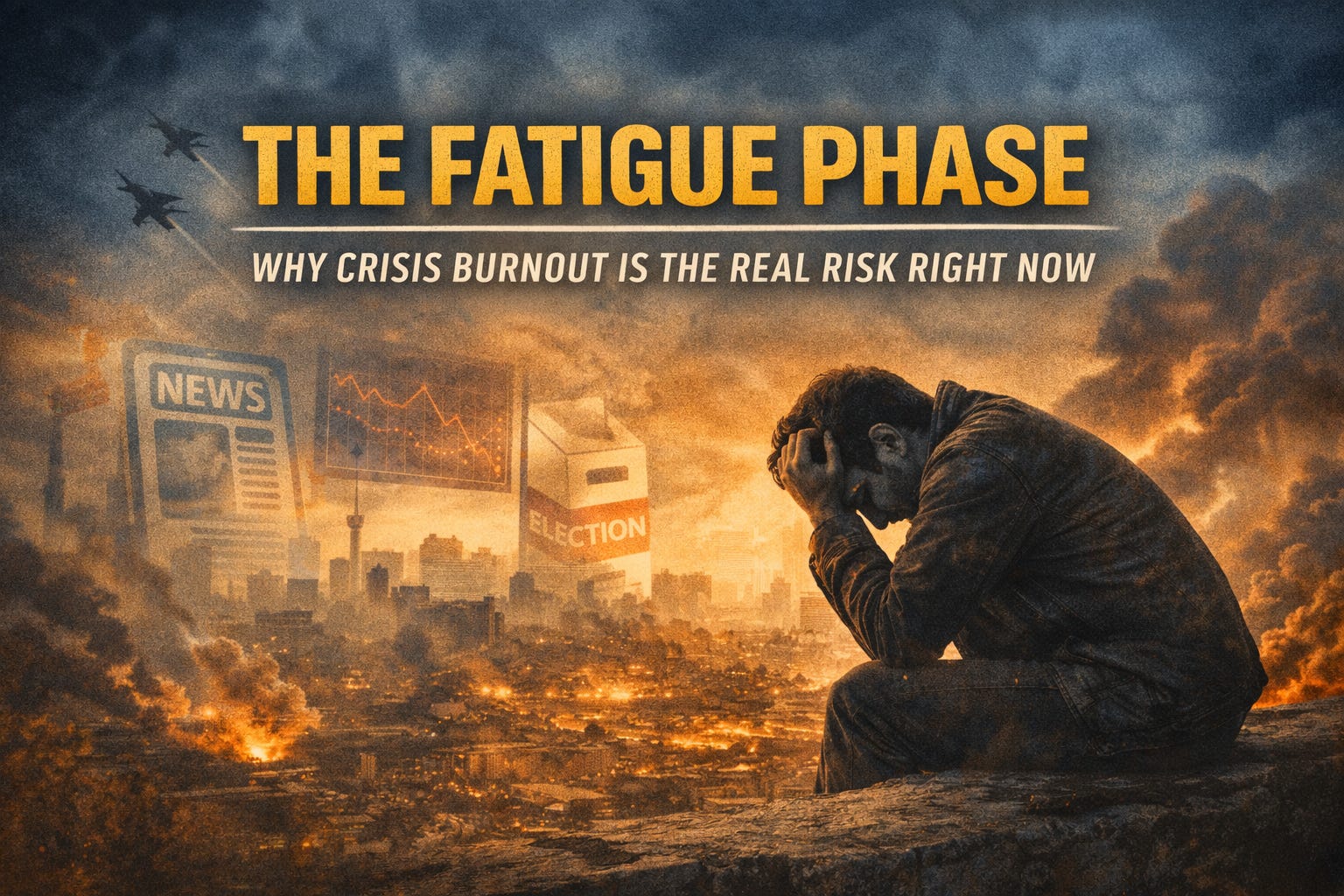
Crisis Saturation Is a Real Operational Risk
In emergency management doctrine, disasters are rarely isolated events. Communities experience compounding stressors, hurricanes followed by power outages, followed by economic downturns, followed by public health emergencies.
But there is another pattern that rarely makes headlines.
Prolonged uncertainty erodes resilience even without a catastrophic event.
This is what we are seeing now.
The public is in a state of constant alert without resolution. Every news cycle feels urgent. Every geopolitical shift is framed as existential. Every domestic conflict is labeled unprecedented.
That level of sustained activation changes behavior.
People stop planning rationally and start reacting emotionally. They doom-scroll instead of assess. They either overprepare dramatically or disengage entirely.
Neither posture is stable.
Case Study: COVID-19 and the Long Burn
The COVID-19 pandemic is the clearest modern example of the fatigue phase in action.
The initial months were marked by high compliance, intense awareness, and rapid behavioral adaptation. People stocked up, reorganized routines, and consumed information obsessively.
But as weeks turned into months, something changed.
Compliance eroded. Messaging lost credibility. People became numb to data dashboards and press conferences. The crisis didn’t disappear, but the public’s ability to process it degraded.
From an emergency management perspective, this is predictable.
The human nervous system is not built for prolonged ambiguity. Acute crises trigger mobilization. Chronic crises trigger depletion.
The second and third waves of COVID did not generate the same public cohesion as the first. Not because the threat disappeared, but because fatigue set in.
We are now experiencing that same pattern, but applied across geopolitics, economics, domestic politics, and media cycles simultaneously.
Case Study: Hurricane Katrina and Institutional Fatigue
After Hurricane Katrina, the initial failure was logistical. Communications collapsed. Coordination faltered. Local governance was overwhelmed.
But what followed was instructive.
Long after floodwaters receded, residents experienced what planners call recovery fatigue. Bureaucratic delays, insurance disputes, housing instability, and repeated media coverage prolonged stress long beyond the physical event.
Communities don’t just break from impact. They break from duration.
The longer uncertainty lingers, the more trust erodes. The more systems strain, the more individual decision-making degrades.
Fatigue becomes its own hazard.
The Emergency Management Lens
In resilience planning, there is a concept known as adaptive capacity.
Adaptive capacity measures how well individuals and communities adjust to stress without systemic failure.
It depends on:
Information clarity
Resource buffers
Institutional trust
Social cohesion
Psychological endurance
Notice what is not on that list.
Drama.
Communities do not collapse because headlines are loud. They collapse when adaptive capacity is drained.
Right now, the real risk is not a single catastrophic event. It is erosion.
Erosion of trust.
Erosion of financial margin.
Erosion of attention.
Erosion of emotional bandwidth.
Preparedness communities often focus on stockpiles and tactics. Emergency managers focus on capacity.
Capacity is what gets you through prolonged stress without making desperate decisions.
The Information Problem
One of the most overlooked contributors to fatigue is information overload.
The modern media ecosystem is not designed to inform calmly. It is designed to sustain engagement. Engagement requires urgency. Urgency requires amplification.
Every geopolitical development is framed as historic. Every political dispute is framed as existential. Every economic indicator is framed as a warning sign.
This constant escalation of tone creates what psychologists call threat inflation.
When everything feels urgent, nothing feels manageable.
And when nothing feels manageable, people either panic or disengage.
Both outcomes reduce resilience.
The Prepper Community’s Blind Spot
Preparedness culture prides itself on vigilance. And vigilance is valuable.
But vigilance without discipline becomes obsession.
When people spend hours tracking military cargo flights, refreshing geopolitical threads, or interpreting every speech as coded collapse, they are not building resilience. They are draining it.
Fatigue is cumulative.
You do not notice it on day one. You notice it when patience thins. When irritability rises. When financial decisions become reactive. When relationships strain.
Emergency managers understand this. After prolonged incidents, they rotate personnel. They enforce rest cycles. They manage exposure to stressors.
Individuals rarely do.
Preparedness without rest becomes fragility disguised as strength.
Case Study: The 2008 Financial Crisis
During the 2008 financial collapse, panic did not peak at the exact moment of market crash. It intensified during prolonged uncertainty.
Housing markets stalled. Credit tightened. Job losses extended over months. People didn’t just suffer economic loss. They suffered decision fatigue.
Small business owners delayed hiring. Families postponed purchases. Investors oscillated between fear and denial.
The crisis was not a single event. It was an extended stressor that reshaped behavior long after headlines cooled.
That is the template for fatigue risk.
It is not the spike. It is the stretch.
Why This Matters Now
Right now, we are living in overlapping stress cycles:
Geopolitical tension
Economic volatility
Cultural polarization
Rapid technological disruption
Institutional distrust
None of these alone guarantees collapse.
Together, sustained over time, they create a draining environment.
And drained people make mistakes.
They overextend financially.
They isolate socially.
They radicalize ideologically.
They disengage from civic responsibility.
Fatigue doesn’t just weaken individuals. It weakens communities.
What Serious Preparedness Looks Like During the Fatigue Phase
If you want to build resilience in this environment, focus less on forecasting and more on conservation.
Information Discipline
Limit exposure to repetitive crisis content. Schedule news consumption. Avoid constant monitoring.Financial Margin
Reduce leverage. Increase liquidity. Volatility is easier to absorb when you are not stretched thin.Routine Stability
Maintain daily structure. Exercise. Sleep. Family time. Routine preserves psychological bandwidth.Community Anchoring
Strong local relationships increase adaptive capacity far more than isolated awareness.Strategic Detachment
You do not need to process every headline to remain informed. Focus on signal, not noise.
Emergency management teaches that sustained operations require rotation and rest.
Apply that principle to yourself.
The Strategic Advantage of Calm
There is an ironic truth here.
In periods of prolonged uncertainty, the competitive advantage shifts to those who remain composed.
Markets reward patience. Communities reward steadiness. Families rely on emotional stability.
The loudest voices online will continue to interpret every development as validation of their worst fears. That does not mean those fears are accurate. It means urgency is profitable.
Battlefield Radio exists to slow that cycle down.
Fatigue is real. It is measurable. And it is one of the most underappreciated risks of our time.
Final Broadcast
The world is not ending this week.
It is straining.
Strain can be managed. Strain can be absorbed. Strain can even strengthen systems when handled correctly.
But strain handled poorly leads to exhaustion.
The fatigue phase is not dramatic. It does not trend on social media. It does not produce cinematic footage.
It produces short tempers, impulsive decisions, financial overreach, and quiet withdrawal.
Preparedness in this season is not about bracing for impact. It is about preserving capacity.
Capacity to think clearly.
Capacity to act deliberately.
Capacity to endure without unraveling.
If you feel tired, that is not weakness. It is a signal.
Adjust accordingly.
Step back when needed. Tighten discipline where it matters. Preserve your margin.
Because in prolonged uncertainty, resilience is not measured by how loudly you react.
It is measured by how long you can remain steady while others burn out.
That is the real test.

Outstanding timing for the advice to take a step back and recognize the patterns of crisis burnout.
Jack Spirko (Survival Podcast) talks about filtering threats this way. There are things that are within my span of control that affect me. I must deal with these. There are things outside my span of control that affect me and my family. I must prepare for these and build resilience/bandwidth/flexibility to see us through (tornado, economic downturn, etc). There are things outside my control that don’t directly affect me and my family and I need to turn down the volume on those and focus my energy on those things ha that leave us best positioned to endure through whatever comes. And, as you just demonstrated- sometimes that just comes down to taking some time to focus on the family and be intentionally present rather than doom scrolling and worrying about the comet that might or might not be an alien artifact. (not in my span of control!)
Thanks for the advice- excellent timing!!!
I’m there with you my friend. I hope all is ok and you are well…. Thinking of you ❤️